
by Tony Cheng – TWP Board Member and Professor, Forest & Rangeland Stewardship, CSU
I was selected to join TWP’s board in early 2026 and was super excited to visit Trees Water and People’s New Mexico office in Santa Fe for the Board meeting on August 5. My relationship with TWP began in the early 2000’s when I started my faculty position in the Forestry program at Colorado State University (CSU). Stuart Conway and Richard Fox were regular and gracious guest speakers for a senior-level forest sustainability course I taught. My students and I learned a great deal about TWP’s mission, activities, and impact, and I have followed and supported TWP ever since. More recently, researchers with the Colorado Forest Restoration Institute at CSU, which I directed from 2008 to 2024, have been communicating with James Calabaza and the Indigenous Lands Program team about TWP’s tree-planting work in old burn scars. So, being in New Mexico for the TWP board meeting was several life-paths converging – and new ones awaiting to tread.
A few things stood out for me from the board meeting. Foremost, the board is comprised of people who deeply care about TWP’s mission and the people – past and present – who go above and beyond in their work. But it’s not a group of cheerleaders. Every person brings a critical eye to each facet of TWP’s operations, from clarifying program strategies and budgets, to asking questions about why, who, and how TWP partners with people and organizations on the ground to make sure actions align with the organization’s values. This is my first turn at being on a nonprofit board, so I’m still learning a lot!
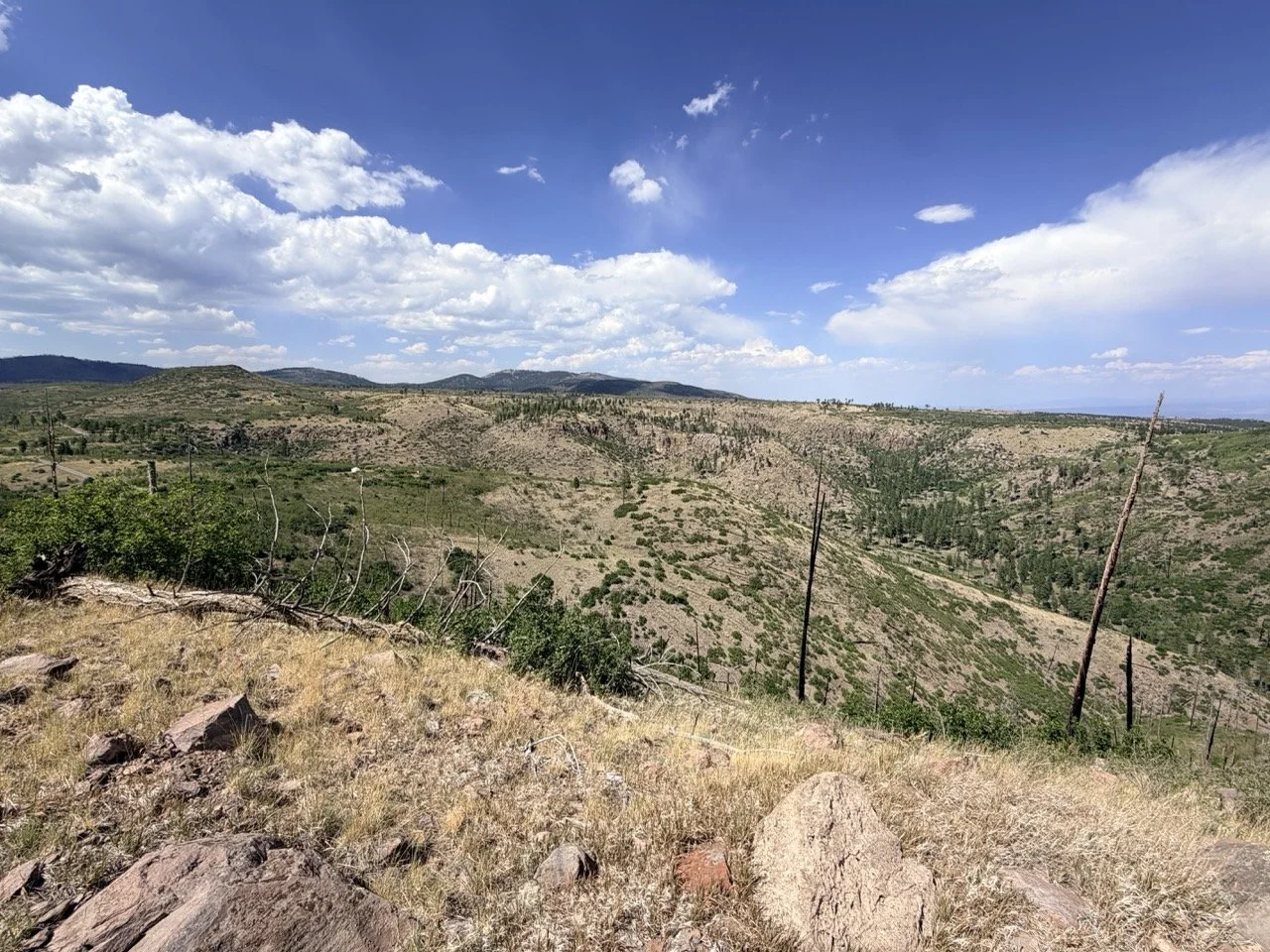
In the afternoon, TWP staff Ally Rael, James Calabaza, and Treston Chee capably drove the board to an overlook over Capulin Creek in Bandelier National Monument about a 90 minute drive northwest of Santa Fe. This watershed burned in the Las Conchas Fire in 2011, a fire that burned over 156,000 acres with a speed and ferocity that left the landscape largely barren of vegetation. The exposed soils lost their water filtering capacity, thereby increasing flooding and sediment into Capulin Creek and eventually into the Rio Grande River. If all goes to plan this Fall, TWP trained and led crews will begin installing in-stream sediment control structures and plant trees. This is arduous work that kicks-starts the long, slow healing process, but it’s a critical first step to restoration. In the process, TWP will provide skill-based training to Indigenous young people from local pueblos and kick-starts the long-slow process of rematriating the land with Indigenous communities. This model of integrated social-ecological restoration work in New Mexico serves as a model for future endeavors. I’ve been in the forest restoration world for a long time and I’m so excited to see the results of the work, and see where TWP can expand this model.